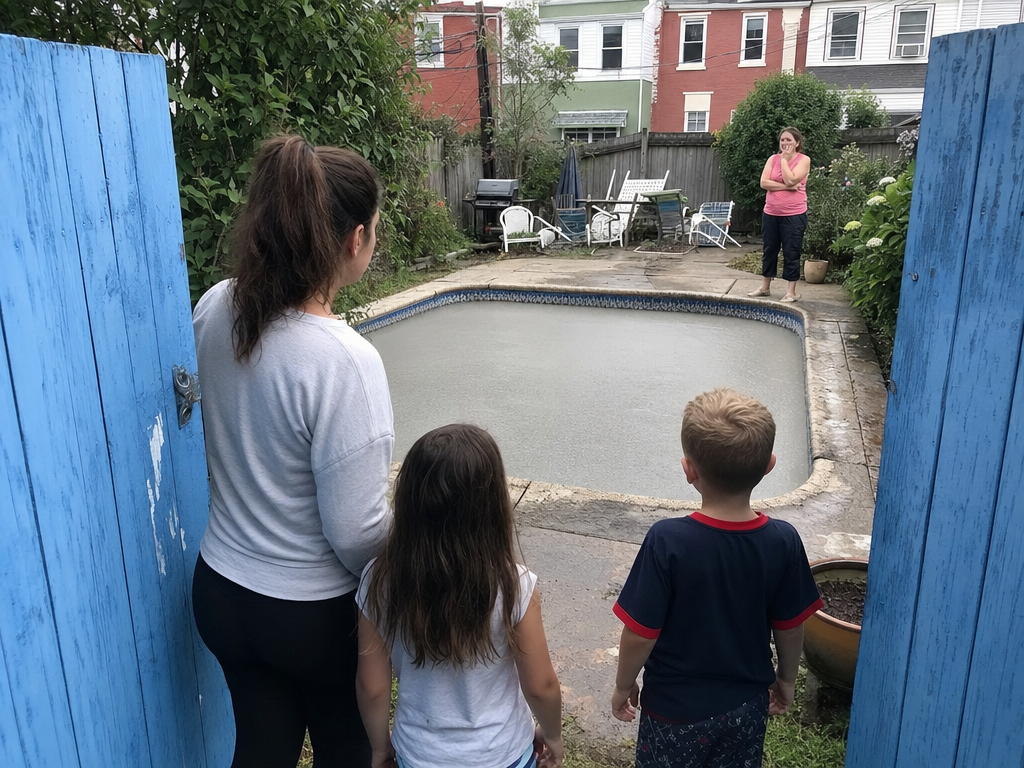
The first thing I noticed was the silence. My children usually reached the blue gate ahead of me, arguing about who would skim leaves from the pool before jumping in. That Friday, both stopped on the sidewalk. A new chain circled the gateposts, and beyond it our courtyard looked dusted in gray. I smelled wet cement before I understood that the bright rectangle where we had eaten breakfast was no longer water.
Concrete filled the pool nearly to the coping. A wooden rake lay abandoned across the surface, one end already hardening into place. My son Leo whispered that his goggles were at the bottom. My daughter Mina asked whether the house still belonged to us. I could answer the second question, but the fact that she had asked it made my hands shake. I called the police nonemergency line, our insurer, and the contractor whose number was taped to the mixer chute.
Our neighbor Rowan came out before anyone arrived. He said he had authorized the work because the children's noise had become unbearable and the unused pool was a hazard. The pool was neither unused nor his. It belonged to the six Alder Street homes through an old courtyard agreement, and I was the elected maintenance contact. Rowan insisted his attorney had found a safety clause. When I asked to see it, he held up a page without signatures.
The concrete foreman returned in a pickup, took one look at my deed packet, and stopped speaking. His work order listed Rowan as courtyard president, a position that did not exist. More troubling, the order described the blue gate as the only truck entrance and emergency route. The foreman glanced toward the clouds, then at the fresh slab. He said the pool's bottom drain had been capped with concrete. Rain was forecast all weekend, and he wanted to know where our stormwater would go.