Three weeks after Nora fell from the Calder Ridge overlook, I brought her backpack home from the sheriff's evidence desk. One strap had been cut by the rescue crew. Dried mud flaked from the zipper, and a pine needle clung to the first-aid pouch. Nora was still at Westlake Rehabilitation, learning how to transfer from bed to chair without twisting her healing spine. She remembered beginning the trail and waking in the hospital, but the four hours between had gone dark.
The official report said she crossed a closed section alone and leaned against a damaged rail. That sentence followed us everywhere. Her insurer used it while questioning extended therapy. The county used it when denying responsibility. Even Nora repeated it, turning a gap in her memory into a verdict against herself. I wanted someone to blame, yet I had no better account. I had taught high school geography for thirty years, and I knew a blank area on a map was not proof that nothing existed there.
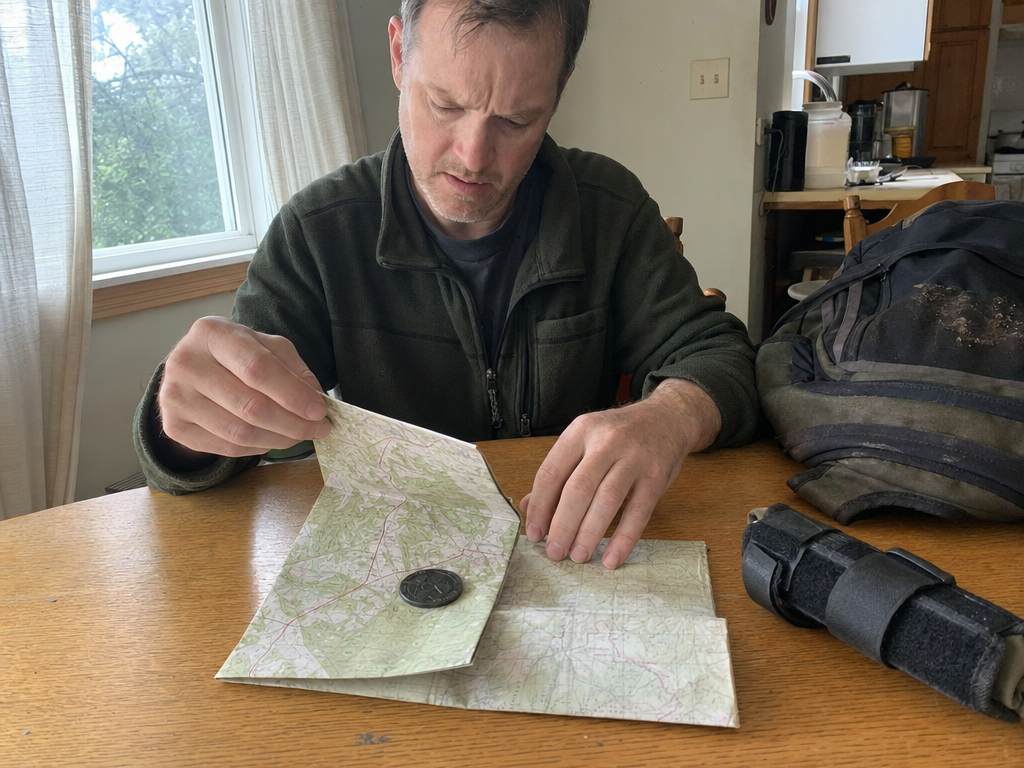
At our kitchen table, I emptied the backpack carefully. There were crushed crackers, a red bandanna, and Nora's folded topographic map. When I lifted it, a matte-black coin rolled into the sugar bowl. It was heavy, chipped at one edge, and stamped with a compass rose over the number twenty-seven. On the rim, nearly hidden beneath soot, someone had scratched three letters: MVR. Nora collected transit tokens, not military keepsakes. I had never seen this coin in her apartment.
Beneath it, the map showed a pencil circle far below the overlook, beside an old maintenance road absent from the public trail guide. The circle was not in Nora's handwriting. A faint arrow led toward a square labeled radio hut, though the hut had been removed years ago. When I turned the coin under the lamp, something pale filled the chipped edge. It was not bare metal. It was a thread of blue plastic, the same shade as the county survey flags visible in photographs of the broken railing.